Wednesday, November 25, 2009

Memories

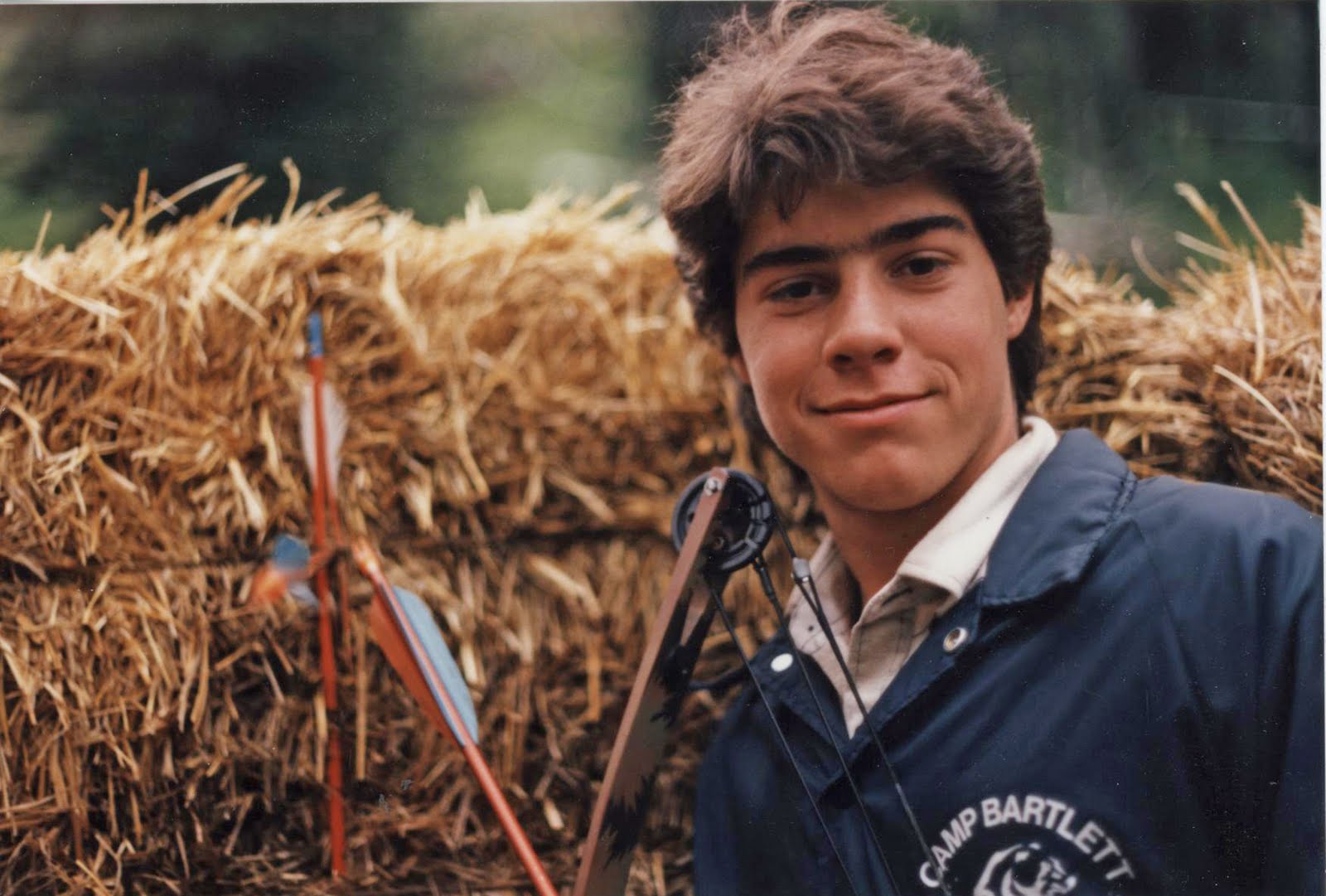
The past few days I have had a chance to recall the “good old days”. Sunday, Trent Warner told me that his family is getting into archery. I recalled the time his split an arrow while shooting at the Loll archery range in 1987. I took a couple of pictures at the time, and am posting them here so he can show his kids how he and Robin Hood "used to do it".

Last night, Jody came for a visit and I recalled how he had rebuilt the pioneering area at Loll. The camp was actually on the verge of being closed down at the end of 1985. “We” came back in 86, and Jody arrived in 87. I recall the Council VP who was pushing to close the camp, walking past Jody’s pioneering class and commenting, "Well it's not so bad; when you get it cleaned up."

It is deeply gratifying to see how these good friends have grown from promising boys to magnificent men. Growing up is also an Art.


Trent Warner splits an arrow at the Camp Loll Range, 1987


Yeoman of the Bowmen

Jody rebuilds the Loll Pioneerning area in 1987. My sons, Shaun and Lafe have also grown up to be magnificent men.


Jody was pretty magnificent back then.

Thursday, November 19, 2009

Tribune on the Afghan War

I had hoped I wouldn’t have to do this, but I just can’t help it. I read the following editorial in the Salt Lake Tribune this morning, November 19, 2009. It could be a parody, a joke of some kind, but I don’t think so.

Afghan war

U. S. should not commit more troops

The cost in blood and treasure is too great. The chance of success, however defined, is too remote. For these reasons, President Obama must not commit more U. S. soldiers to an open-ended war in Afghanistan. Rather, he should begin the diplomatic and military preparations to bring U. S. forces home.

Everyone understands the stakes. Everyone regrets that Osama bin Laden and the other leaders of al-Qaida have eluded capture or death at U.S hands. Everyone understands that as the Americans and their allies leave Afghanistan, civil war will certainly ensue and the Taliban could once again emerge victorious, creating in their wake a new safe haven for al-Qaida and other terrorists.

It is obvious, as well, that Islamist radical pose an existential threat not only to Afghanistan but to neighboring Pakistan, a nuclear-armed state.

But the fundamental; question is whether the American army in Afghanistan helps or hurts U. S. security. It has become increasingly apparent that the ongoing eight-year war there cements hatred of the United States among the Afghans because the Americans are viewed as infidel invaders and occupiers who support a corrupt and illegitimate government. The fraudulent election that returned Hamid Karzai to power has revealed it to be so.

Nor does there appear to be much chance that the war lords the United States put in power during the fighting to topple the Taliban can be dislodged and replaced by a democratically elected government based on some western model or even an Afghan one. Without a legitimate government as a partner, the U.S. effort to pacify the country and somehow protect the civilian population from the predation of the Taliban and tribal warlords is, if not hopeless, a very long shot.

Without a claim on the loyalty of the people, Karzai’s government cannot reasonably be expected to field a notional army and police force capable of protecting them.

Gen. Stanly McChrystal’s request for up to 40,000 more U.S. troops, in addition to the 68,00 already committed, is an honest plan to turn back the Taliban tide and shore up Karzai’s government, but given the political facts of Afghanistan, it is hard to see how it can work.

In addition to the human cost, the price of that effort would be an additional $40 billion to $54 billion a year. Given the weak U.S. economy and trillion-dollar federal deficits, that is more than the American people can afford.

It’s time to plan to get out.

Now with my commentary:

Afghan war

U. S. should not commit more troops

The cost in blood and treasure is too great. The chance of success, however defined, is too remote. For these reasons, President Obama must not commit more U. S. soldiers to an open-ended war in Afghanistan. Rather, he should begin the diplomatic and military preparations to bring U. S. forces home.

Everyone understands the stakes. Everyone regrets that Osama bin Laden and the other leaders of al-Qaida have eluded capture or death at U.S hands. Everyone understands that as the Americans and their allies leave Afghanistan, civil war will certainly ensue and the Taliban could once again emerge victorious, creating in their wake a new safe haven for al-Qaida and other terrorists.

*So let’s just let these things happen? Let’s remember what the Taliban did to the people of Afghanistan: women buried alive for not wearing the right clothing, girls killed for studying, widowed women murdered for trying to get jobs to feed themselves and their children, ancient statues of the Buddha blown up, people beaten to death for listening to music, people executed for teaching or converting to Christianity etc. etc. etc. And don’t we remember what they did to America the last time they had a base in Afghanistan? 9/11 – how can that be better than war?

It is obvious, as well, that Islamist radical pose an existential threat not only to Afghanistan but to neighboring Pakistan, a nuclear-armed state.

*We won’t need to worry about Iran giving the terrorists nukes – they will have their own. Do we really have any doubt where Allah will tell them were to set them off?

But the fundamental; question is whether the American army in Afghanistan helps or hurts U. S. security. It has become increasingly apparent that the ongoing eight-year war there cements hatred of the United States among the Afghans because the Americans are viewed as infidel invaders and occupiers who support a corrupt and illegitimate government.

*As if they didn’t hate us before? Wasn’t 9/11 before we liberated Afghanistan? How much can people hate anyway? The fanatics imagine that God has told them to hate and kill us – is there anything we can do that would make them hate us more. Also the people of Afghanistan, who are not terrorists, want US support and help. It is reasonable to assume that anyone would prefer US liberation to Taliban domination. What Afghans fear most is that we will leave them.

The fraudulent election that returned Hamid Karzai to power has revealed it to be so.

Nor does there appear to be much chance that the war lords the United States put in power during the fighting to topple the Taliban can be dislodged and replaced by a democratically elected government based on some western model or even an Afghan one.

*Karzai’s government isn’t legitimate? What? Was ACORN over there registering dead people? Karzai was constitutionally inaugurated today – note that the people did get to vote for him - something that Mullah Omar never offered them.

Without a legitimate government as a partner, the U.S. effort to pacify the country and somehow protect the civilian population from the predation of the Taliban and tribal warlords is, if not hopeless, a very long shot.

*Was Stalin’s monster dictatorship in the USSR a disqualifier for our support of that nation against the Nazis? According to the Tribune’s logic, we should have left Russia to the Germans, France too for that matter – at least the Vichy variety. We have no memory of history. It’s very hard to find perfect governments to ally with in this world. Just how legitimate is the government of Red China? I must now expect the Tribune to lecture Obama about meeting with Wu.

Without a claim on the loyalty of the people, Karzai’s government cannot reasonably be expected to field a notional army and police force capable of protecting them.

*It seems that China is able to field an army without any legitimacy of government – same with North Korea, Vietnam, Cuba, Venezuela; do I really need to go back to the etc.’s? Seems most of these police states in the world have pretty effective police departments as well.

Gen. Stanly McChrystal’s request for up to 40,000 more U.S. troops, in addition to the 68,00 already committed, is an honest plan to turn back the Taliban tide and shore up Karzai’s government, but given the political facts of Afghanistan, it is hard to see how it can work.

*Should we give up because it’s hard? I wonder what George Washington and the boys at Valley Forge would think of that advice? It seems that the Normandy landing was a little difficult, not to mention the “surge” in Iraq. War is difficult by definition. Easy is writing editorials for a third rate city rag! What kind of county is the Tribune advocating? Is their advice to all people in all circumstances – if the going gets tough give it up?

In addition to the human cost, the price of that effort would be an additional $40 billion to $54 billion a year. Given the weak U.S. economy and trillion-dollar federal deficits, that is more than the American people can afford.

*And how much will the next terror attack cost, what will it cost to rebuild an American city nuked by a Pakistani engineered device? Can anyone remember what 9/11 did to our economy? How much blood and treasure will it cost to go back to Afghanistan to get the terrorist – which the Tribune admits will develop – after their next mass slaughter of Americans, or other western and free people? We are asked to spend trillions for health care for people who won’t buy their own but we are told it is too much to make an investment in world peace, freedom, and the defense of our very way of life. I was brought up believing that Americans would pay millions (billions) for defense and not a cent for tribute. Who is the Tribune working for? What country are they talking about?

I can’ t wait till the Tribune go out of business. I’d cancel my subscription if I had one. I got the paper I read this morning for free – it wasn’t worth the price.

It’s time to plan get out.

*That’s cut and run. Let millions die, let fanaticism and fear grow, let’s be stupid.
Tuesday, November 17, 2009

A Bow to the Emperor

Obama’s bow to the Emperor of Japan was appropriate. Let me reiterate; there is nothing to regret in Obama’s bow to Akihito. I lived in Japan for most of two years and bowed dozens of times a day; it is the same as shaking hands. That the President of the United States had the courtesy to correctly observe the custom showed he is secure in his position as the world’s most powerful man and leader of the world’s most powerful nation. To construe any submission to the Emperor of Japan in Obama’s act is not reasonable.

On the other hand, I am forced to muse on what might have reasonably been running through the Emperor’s mind as he looked down on Obama’s head. He could have thought to himself: “Too bad you weren’t President of the United States in 1941. If you had been, my father, Hirohito, would have won the war, and I would be the most powerful man on earth."

Following the attack on Pearl Harbor, FDR sent 7,000,000 U.S. troops into terrible war. America’s military saved our freedom and the world, and insured our nation’s preeminence. Obama is troubled at sending 40,000 troops to Afghanistan in order to win the War on Terror. The Afghan based Terrorist who attacked America on 9/11 killed as many Americas as the Japanese Imperial Fleet did on December 7, 1941. The terror attack had a far greater negative impact on our national economy than the loss of a few old battle ships in the Pacific. These terrorist are still determined to destroy not only our lives but our way of life, and Obama is looking for a way to give up the fight.

Let’s be reasonable. George Bush sent the troops that liberated Afghanistan and Iraq and he kept the U. S. homeland safe from terrorist attack for eight years. Obama has lost it all in nine months. Now that is submission we will all regret.

Monday, November 16, 2009

Very Basic Art Lessons - #5 - Drawing the Head


Human Anatomy


Note: The human figure is the most difficult illusion to create in representational Art. It is the image of God; therefore the most sublime demonstration of beauty and truth. The laws that make its depiction possible are universally applicable to all Art and their mastery key to unlocking Art's secrets. For this reason Very Basic Art Lessons moves directly from Perspective, the way we see things, to the Human Form, the things we see.


Sunday, November 15, 2009

Figure Drawing from the 1990's

I think Art is a manifestation of man’s desire to create. It is the germ of our divine nature, our hope for immortality, an aspiration; perhaps our pride. It relates to and transcends our desire to possess the good, the beautiful, and the true. We want to add to their store in the Universe.

For years I was an avid hunter and fisherman. I wanted to hold the things I loved, birds and beasts and bright colored fish. In the same way I have long been driven to collect, trinkets and treasures, photographs, letters, books, and memories. Once, on my mission another elder asked what I was collecting while in Japan. A member interjected, “Kana Choro collects people.” A treasured complement; I collected it. Then came the family, wife, five children, and then the grandsons; what a piece of work.

Creating art seems a more transcendent goal than killing ducks, if not as worth as making friends or have children. The force that drives all this joy seems rooted in the most primal of passions.

To me, drawing a human figure is at once the most desired and the most intimidating face of art. Everyone knows what a person looks like, even though they don’t all know why; thus we see every flaw. It is particularly intimidating to draw a picture that is to look like someone, especially a someone you care about; a friend or family member.

Any of my efforts at figurative work before 1990 were both fractured and poor, an occasional hand, eye, or ear. I did try a few heads for my Art Classes at BYU and USU, but they are so grotesque, that even in this retrospective, I cannot bring myself to reference them. I entered the 1990’s determined, to produce acceptable representations of the human form. This quest has driven my artistic study ever since. I have produced books full of non-figurative sketches, but even they are only supportive of my ultimate goal. There is no experience in art as powerful as creating a beautiful figure and being able to look at it and say, now you are real: before I created you, there was only dust.

1991

This drawing is a good starting point. As my great master, Robert Beverly Hale, would point out – I was drawing what I saw – eyes and ears and nose and hair – but I knew nothing about them, grasped no relationship between them. I didn't know the forms which represent them in the illusion of three-dimensional space, or what was beneath the surface, the actual froms that produced the face. When I drew them, they were unconnected. Yet at the time I took hope.


Since I was only drawing bits and pieces, limiting my drawings to bits was more successful.


1992

I was reading books; looking at pictures, and asking questions. I asked Mr. Egan, our high school Art teacher, how to draw a nose. He showed a simple stylization. I would us it over and over again. I discovered that there were ideal proportions and positions of the features on the face. I’m afraid even with the book in front of me I had trouble getting them right.


1993

I tried this one of my son Lafe, from a photograph. I didn’t know how to make the pencil marks. I could see the value changes but had no idea what made them, that which needed to be recorded by my tools and those which needed to be rejected by my mind. One must learn to draw with the mind.


Lafe

1994

Since realism wasn’t working for me I decided to simplify – to turn to the “cartoon”. Through the spring of 94, I drew dozens of these faces and figures. Some a bit shocking – but I was pleased with many. Below I have chosen a representative few.


.
.
.
.


I returned from camp that fall determined to master drawing. I had read more books – and determined to make a series of drawing of some of the guys who had worked for me over the years. I forced myself to draw every day. I learned a lot – mostly I learned that I didn’t know what I was doing.


Brian Bock


Doug Hopper
.

Trent Warner

Jody Orme

Chris Carter

Eric Mcpherson


Ashley Brimhall

So many wonderful models, again I was learning, mostly that I didn’t know what I was doing. Looking at the odd creations I wonder that they ever pleased me, but they did. I decided that I needed to take Art Lessons.

1995

I was no longer the Debate Coach at the high school. Suddenly, I had time to get instruction. I was lucky enough to find a great teacher, Rob McKay. A successful illustrator, he was an exception to most of the “Fine Art” teachers at the U. I have had class from several of them. They didn’t have much to teach, caught up in relitivism they didn't see much use in rule, but rules are what I needed most. Rob, on the other-hand, was willing and able to share what I needed to know. I learned that I had a long way to go. Below are some of the exercises he had me do.

One must master the basic shapes, one must know the forms of the forms.


And one must understand what it is, that just below the surface, creates what we see.


Instruction does make a difference. A teacher, and the truth he can teach are key to progress. By the end of that year I was producing much more satisfactory work. But I was still just learning.


I now knew of such things as line and value. Not really how to use them, I was not their master, but I could see them.


(detail)

1996

I still could not do what I wanted to do, what I thought “real artists” do. Draw anything from life. I did try – not with much success – but then I had also learned that success was going to be a long time in coming. I made models of my children. They are so beautiful.

My son Bryon

My Daughter Alison

I was not the debate coach, but I was the assistant director of the school play. It was Ron Peterson’s last year. Together we did A Man for All Seasons. My son Bryon had a part, as did one of my favorite students, J. R. Hankins. I had also taken a watercolor class. I tried combining my learning. These are from Photographs. I still own the one of Bryon – I gave the original of J. R. to Mr. P.

(detail)


Thomas Moore, the Layton High version, in "the" tower. (detail)

After the play, I tried this drawing of Curtis Weller. It is from a picture I took at Yellowstone Lake. I hope he will forgive me. Still so far to go.
.

(detail)

1997

I came back from Camp that fall determined to do better. I found a book on drawing portraits from photos, I pored over it and did all the drills.


Then I tried some drawings from photos. First Socrates, then Deng Xiaoping, finally Jody Orme.


I tried to remembre what is inside.


1998

Photographs are OK but I still longed to draw from life. Rob told me about the life drawing classes every Saturday at the U of U. I started attending every Saturday. Week after week I spent several hours trying to capture the illusion of the human form. I was quite pleased at the time, now looking back at my efforts of the time – well let’s just say, I only found one I cared to share. I learned a lot – but then a miracle occurred. Posted on the bulletin board by the elevator was an advertisement for art lessons by Kamille Corry.
.

(detail)
.
I called and asked for a chance to learn. After reviewing my portfolio she accepted me as a student. Thus began a two years of wonderful instruction. I found a teacher who knew the truth, and was willing to share it. Only my own weakness would hold me back. It was so wonderful to have an honest critic. Someone who taught techniques and truth, who told me straight out what was right and pointed out when I was wrong.
She shared with me the secrets of “Classical Academic Training”. We began by copying Charles Bargue lithographs.
.

.

Homer


The Belvedere Torso

As I studied with Kamille, I continued to go to the University’s Figure Drawing sessions each Saturday.


(detail)

(detail)

(detail)


(detail)

1999

Then we moved on to cast drawings. First a hand, then a head; drawn on fine Italian paper with vine charcoal. These are full sized sight/size drawing. Kamille carefully trained and truthfully critiqued. She taught me how to hold the charcoal, how to erase, how to keep my lines parallel; how to measure and keep scale and position, and always to be thinking about the why of everything. It was like magic.


(detail)
.

Head of Laocoon (detail)

I continued drawubg at the U each Saturday. These are only a few of the drawings I did.

(detail)
.


Meanwhile Kamille showed me more and more. Under her direction I tried a “full” figure done in both vine and white chalk on gray paper. Learning by doing value, line, highlight, and half tone.


(detail)


After "cast drawing" came copying from the masters.

Then the decade was over – the new millennium arrived. I had come a way, I had learned some truth.